
Opening Scene
Stand on the same rooftop from Article 10, a full ten articles later. The city hasn’t stopped changing since that first reassembly. New wings have gone up beside the pantry-organized grocery district and the department-store shopping strip. Some old, condemned structures have finally, safely come down, their tenants long since moved to better wings built specifically to receive them. A citywide compatibility office now checks every borough’s renovation plans against its neighbors’ actual needs, and somewhere in that office, a contractor capable of holding every blueprint in the entire city in mind at once quietly flags a meaning shift nobody else would have caught.
This is still not a finished city. It never was going to be. What changed across these last ten articles is that the city learned how to keep being built on, safely, without ever needing to be torn down and started over.
In Plain English
Schema evolution and versioning was never really a separate discipline bolted onto data modelling — it’s what happens to good modelling once real time and real change enter the picture. Every technique in this closing arc — additive changes, breaking-change identification, versioning, compatibility, expand-contract, deprecation, distributed coordination, and comprehensive AI-assisted impact analysis — exists for one reason: to let a schema keep changing, safely, for as long as the system it describes keeps mattering.
The Whole Arc, Reassembled
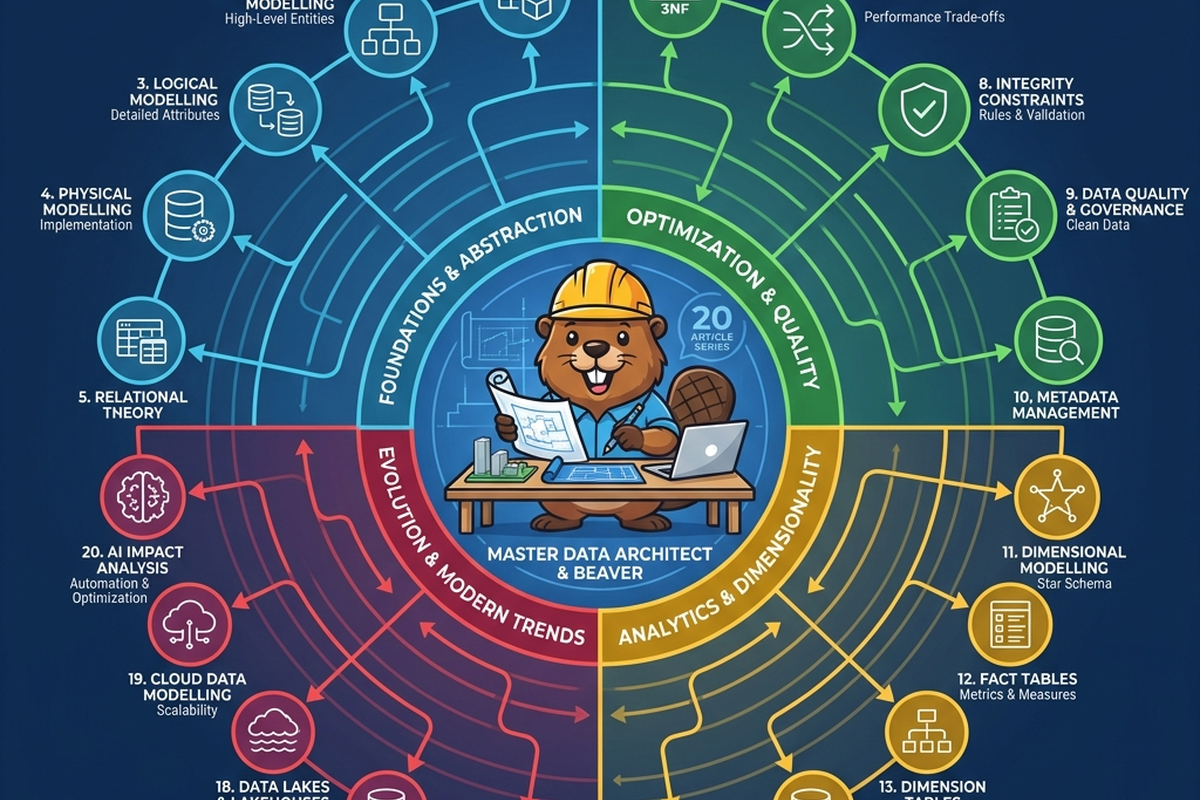
- Articles 1 through 10 built the city itself: entities and relationships, normalization, dimensional design, warehouse and lake thinking, a first pass at safe renovation, AI-assisted drafting, and semantic layers — reassembled once already as one connected, AI-ready whole.
- Articles 11 through 14 established this closing arc’s foundations: distinguishing additive changes from genuinely breaking ones, versioning a schema honestly, and designing for real backward and forward compatibility during a phased transition.
- Articles 15 through 17 grounded that foundation in real process: deliberate change review and governance, the expand-contract pattern for executing a breaking change safely, and a genuine deprecation window before anything old is actually removed.
- Articles 18 and 19 stepped back to the largest possible scale: schema evolution across a genuinely decentralized, multi-service organization, and AI-assisted impact analysis comprehensive enough to catch what no single team could ever see alone.
What’s Changing (and Why AI Is the Reason), Revisited
Across this closing arc, AI’s role has been consistent with the rest of this series: it has never replaced the judgment schema evolution has always required, but it has made that judgment dramatically more reliable and less exhausting to apply consistently. AI has classified changes as additive or breaking faster and more consistently than manual review ever could (Articles 11, 12), enforced versioning and compatibility guarantees that used to depend on individual discipline (Articles 13, 14), automated the mechanical parts of review and migration tracking so human attention could focus on genuine judgment calls (Articles 15, 16, 17), and extended visibility far past what any single team could ever see on its own, across service boundaries and across an entire organization’s downstream systems at once (Articles 18, 19).
The Metaphor, Fully Extended, One Last Time
| City Element | The Schema Evolution Lesson It Carries |
|---|---|
| A new room added without displacing anyone already living in the house | Additive changes, the safest category of schema evolution |
| Structural drawings showing exactly which walls are load-bearing | Identifying genuinely breaking changes before anyone touches them |
| A cornerstone plaque and a permit office, both keeping an honest record | Schema versioning and governance, making change trackable and reviewed |
| Tenants moved to a new wing before the old one is ever demolished | The expand-contract pattern, sequencing a breaking change safely |
| A contractor capable of holding every blueprint in the city in mind at once | Comprehensive AI-assisted impact analysis, catching what no single view ever could |
For Beginners: What to Actually Do
- Return to Article 11 whenever you need this closing arc’s foundational distinction — additive versus breaking — freshly in mind.
- Treat the expand-contract pattern from Article 16 as the single technique worth internalizing above all others in this arc, since it’s what makes a genuinely breaking change survivable.
- Practice checking your own proposed changes against this arc’s disciplines before requesting review, rather than treating review as the first line of defense.
- Revisit this capstone whenever you need the full twenty-article picture — the city itself, and how it keeps being safely built on — reassembled at once.
For Practitioners and Leaders: The Deeper Layer
- Build organizational fluency in this closing arc’s full toolkit, since a mature schema evolution practice needs more than good intentions to handle real, ongoing change safely.
- Use the AI-assisted capabilities covered throughout this arc — classification, compatibility enforcement, migration tracking, comprehensive impact analysis — as genuine force multipliers for schema evolution discipline, not replacements for understanding it.
- Recognize that decentralized, multi-service schema evolution, covered in Article 18, requires more automated tooling precisely because no single team retains full visibility into the whole system.
- Treat schema evolution discipline as a durable organizational asset, one that determines whether your data models can keep serving a business that keeps changing, without ever needing a costly, disruptive rebuild.
Quick Recap
- This closing arc traced schema evolution from distinguishing additive and breaking changes, through versioning, compatibility, governance, and safe migration, to distributed coordination and comprehensive AI-assisted impact analysis.
- The expand-contract pattern is the single technique nearly every other discipline in this arc builds toward executing safely.
- AI has consistently classified changes, enforced compatibility, automated mechanical review work, and extended impact visibility far past what any single team could see alone.
- The city’s real achievement across all twenty articles isn’t that it got finished — it’s that it learned how to keep being built on safely, indefinitely.
Where This Fits in the Series
This second and final capstone closes the full twenty-article arc, reassembling both the original city-building series and this closing schema evolution extension into one connected whole. If you’re returning to this series later, Article 1’s rolled-up blueprint is the natural starting point for anyone new to data modelling, Article 10 is the natural midpoint reassembly, and this article is the one to revisit whenever you need the entire picture, foundation and ongoing evolution both, at once.
Subscribe to the Newsletter
Get the latest DataParables articles delivered straight to your inbox.