
Opening Scene
Older buildings often carry a cornerstone plaque recording the year they were built, and sometimes the year of a major renovation. Anyone consulting old records — an insurer, an inspector, a future renovator — can look at that plaque and know exactly which version of the building they’re dealing with, without having to guess from the brickwork alone.
Schema versioning gives a database schema this exact same clear, honest record.
In Plain English
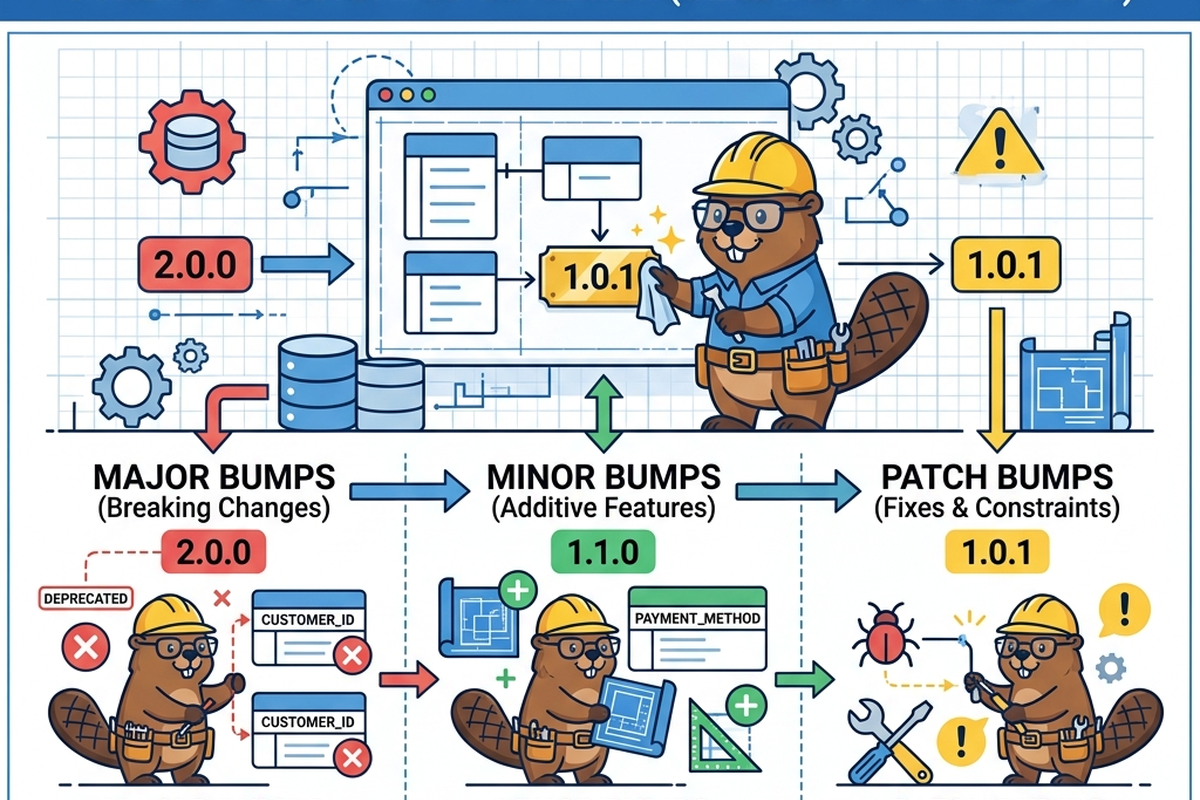
Schema versioning assigns an explicit, trackable version identifier to a schema, incrementing it according to a clear scheme — often mirroring semantic versioning, where additive changes bump a minor version and breaking changes bump a major version — so any consumer can know, at a glance, exactly which version of a schema they’re working against and what kind of change separates it from any other version.
The Old Way
Before deliberate schema versioning schemes, tracking exactly which version of a schema was in use relied on much fuzzier signals:
- Schemas were sometimes tracked only implicitly, by deployment date or by “whatever’s currently in production,” similar to a building with no cornerstone plaque, leaving anyone consulting it to guess its history from context clues alone.
- Without a clear versioning scheme, teams had no quick way to tell whether two schema versions differed by a safe addition or a genuinely breaking change, just by looking at the version identifiers themselves.
- Coordinating a migration across multiple consumers was harder without an agreed, shared vocabulary for “which version are you on,” leading to real confusion about compatibility during a transition.
This implicit, fuzzy tracking is precisely what deliberate schema versioning schemes were built to replace.
What’s Changing (and Why AI Is the Reason)
- AI-assisted version number suggestion can now analyze a proposed schema change, using the additive-versus-breaking classification covered in Articles 11 and 12, and recommend the correct version bump automatically, rather than requiring a human to manually apply a versioning convention consistently every time. This directly operationalizes the earlier articles’ classification work into a concrete, trackable version identifier.
- Schema registries with built-in version tracking can now enforce that a proposed schema change actually matches its claimed version bump, catching a mismatch — a breaking change mislabeled as a minor version — before it ships and misleads consumers about compatibility. This closes a genuine trust gap where a version number itself could be wrong.
- AI-assisted compatibility checking can automatically verify that a new schema version is genuinely compatible with the version it claims to be compatible with, rather than relying on the version number alone as an unverified promise. This turns schema versioning from a documentation convention into a genuinely checked guarantee.
The Metaphor, Fully Extended
| Building Element | Schema Versioning Concept |
|---|---|
| A cornerstone plaque recording the exact year and revision | An explicit, trackable schema version identifier |
| A building with no plaque, leaving history to guesswork | A schema tracked only implicitly, with no clear version record |
| A plaque distinguishing a minor touch-up year from a major rebuild year | A versioning scheme distinguishing minor additive bumps from major breaking bumps |
| A building inspector checking that renovation records actually match the plaque’s claimed history | A schema registry verifying a proposed change actually matches its claimed version bump |
| An insurer confirming a building’s structural rating genuinely matches its recorded revision | AI-assisted compatibility checking verifying a schema version’s compatibility claim |
For Beginners: What to Actually Do
- Get comfortable with a semantic-versioning-style mental model: additive changes bump a minor version, breaking changes bump a major version.
- Never assume a schema’s current state without checking its actual version identifier.
- Use AI-assisted version suggestion as a helpful check, but verify it against the actual additive-versus-breaking classification from Articles 11 and 12.
- Notice that a version number is only trustworthy if it’s actually enforced, not just a convention people try to remember.
For Practitioners and Leaders: The Deeper Layer
- Adopt an explicit, documented schema versioning scheme across your organization, rather than relying on implicit tracking by deployment date.
- Use a schema registry that enforces version bumps match actual change classification, closing the gap where a version number itself could be wrong.
- Use AI-assisted compatibility checking to verify version compatibility claims are genuinely true, not just asserted.
- Treat schema versioning as the foundation that makes coordinated migration, covered later in this arc, actually tractable across multiple consumers.
Quick Recap
- Schema versioning assigns an explicit, trackable version identifier to a schema, incrementing according to a clear, semantic-versioning-style scheme.
- This directly parallels a cornerstone plaque recording a building’s exact construction and renovation history.
- AI-assisted version suggestion and schema registries with enforcement can now ensure a version number actually matches the real nature of a change.
- AI-assisted compatibility checking turns a version’s compatibility claim from an unverified promise into a genuinely checked guarantee.
Where This Fits in the Series
Article 12 covered identifying which walls are load-bearing. This article covered the plaque on the cornerstone — schema versioning itself. Article 14 looks at two crews reading the same blueprint during a phased rollout.
Subscribe to the Newsletter
Get the latest DataParables articles delivered straight to your inbox.