
Opening Scene
Imagine a sports team that suddenly gets access to an extraordinarily versatile new player — someone who can competently fill almost any position on the field, tirelessly, without ever needing a rest. It’s tempting to just hand them a jersey and let them loose wherever there’s a gap.
But any good coach knows that’s not how you build a winning team. If the new player takes over every position, the rest of the roster doesn’t get better — they get sidelined, or worse, deskilled. If nobody redefines who’s coaching, who’s reviewing game tape, who’s calling plays versus executing them, you don’t get a stronger team. You get confusion, overlap, and eventually, players who don’t know what their job is anymore.
The smart move is to actually redesign the lineup: figure out where the new player adds the most value, which existing players shift into different, often more valuable roles — coaching, reviewing, strategizing — and how the whole team’s chemistry needs to change. That’s exactly the conversation analytics teams need to have right now, with AI as the extraordinarily versatile new player who just joined the roster.
In Plain English
Adding AI into your analytics architecture doesn’t just change your tools and pipelines — it changes what the people on your team actually spend their time doing. Tasks that used to be the core job (writing queries, building dashboards, cleaning data) are increasingly things AI can do a first pass on. That means the valuable human work shifts toward things like reviewing AI output, defining what “correct” even means, and deciding where AI shouldn’t be used at all.
This is a real org design problem, not just a training issue — it deserves the same intentional thinking as any other part of the architecture in this series.
The Old Way
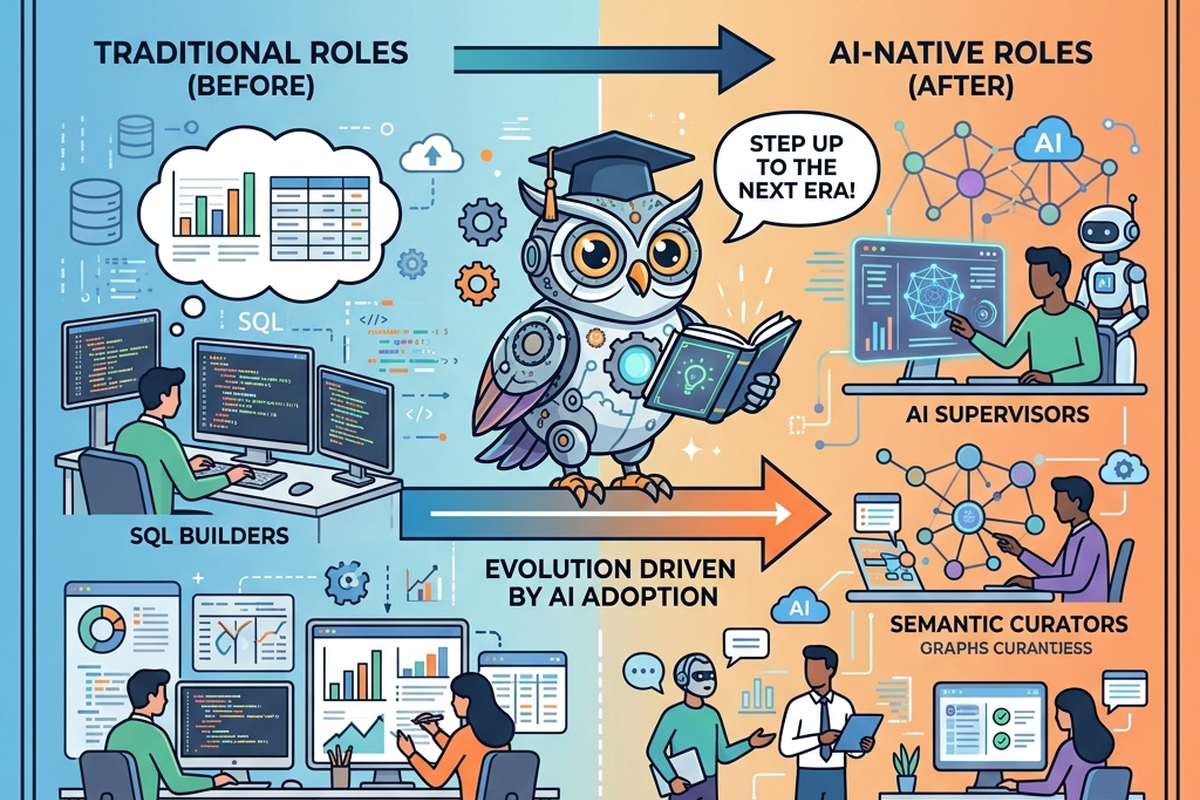
In the traditional analytics team, roles were built around tasks that were entirely human-performed, start to finish:
- Every player has a clearly defined position — the analyst writes queries and builds dashboards, the engineer builds pipelines, the data steward maintains documentation — each role mapped neatly to a set of tasks only a human could do.
- The coaching staff reviews game tape after the fact — managers and leads check in on output periodically, mostly trusting that if a human did the work, the process behind it was sound.
- Skill development means getting better at your position — career growth was largely about becoming a better query writer, a better dashboard designer, a better pipeline engineer, within a fixed role.
This worked because the tasks themselves required a human from end to end. There was no question of “who reviews the AI’s first draft,” because there was no AI first draft — every task started and ended with a person.
What’s Changing (and Why AI Is the Reason)
1. The new player can credibly fill positions that used to require years of training. AI can now produce a competent first draft of a query, a dashboard, a data cleaning step, or a summary — tasks that used to be the entire job description for entry-level roles. That doesn’t mean those roles disappear, but it does mean the valuable part of the job shifts away from “produce the first draft” and toward “judge whether the draft is right.”
2. Some players become coaches, not just because of seniority, but because of necessity. As AI produces more first-draft work, more humans need to be in a position to review, correct, and contextualize that output rather than always producing things from scratch themselves. This isn’t a demotion — a good coach is often more valuable than any single player — but it’s a real shift in what day-to-day work looks like, and it needs to be named and supported, not left implicit.
3. New positions are emerging that didn’t exist on the old roster at all. Someone needs to own the semantic layer’s accuracy (Article 2). Someone needs to define what counts as an acceptable AI-augmented output versus what needs a human checkpoint (Article 4). Someone needs to watch the inference cost budget (Article 8). These aren’t natural extensions of old job titles — they’re closer to genuinely new positions the team didn’t need before the new player joined.
This is the real shift: AI isn’t just a tool that makes existing roles faster. It’s a roster change that requires actually redesigning the lineup — deliberately, not by accident.
The Metaphor, Fully Extended
| The Sports Team (Metaphor) | The Organization (Real World) |
|---|---|
| The extraordinarily versatile new player | AI integrated into analytics workflows |
| Handing the new player a jersey and letting them play anywhere | Adopting AI tools without rethinking team roles and responsibilities |
| A player whose old job was “produce a first draft” | An analyst role historically focused on hands-on query writing or dashboard building |
| A player shifting into a coaching or game-tape-review role | An analyst whose role shifts toward reviewing and correcting AI-generated outputs |
| The play-caller deciding strategy before the game | Someone responsible for defining what “good” looks like — acceptable quality, risk tolerance, where AI should and shouldn’t be used |
| A new specialist position that didn’t exist on the old roster | New roles like semantic layer owner, AI-output reviewer, or inference-cost owner |
| A team that lets the new player do everything, sidelining the rest of the roster | An org that over-relies on AI output without maintaining human expertise and judgment underneath it |
| A coach actively redesigning the lineup, position by position, rather than assuming things will sort themselves out | Leadership deliberately redefining roles and responsibilities, rather than letting AI adoption happen by accident, team by team |
For Beginners: What to Actually Do
- Reframe your own value away from “I can produce this” and toward “I can tell if this is right.” Being able to evaluate, correct, and improve an AI-generated query, summary, or analysis is becoming at least as valuable as being able to produce one from scratch — invest in that judgment early.
- Look for the new positions opening up, not just the old ones changing. Roles around semantic layer ownership, AI output review, and data quality curation are genuinely new opportunities, often available to people earlier in their careers than the equivalent “senior architect” roles used to be.
- Don’t assume AI doing a task well means you don’t need to learn the fundamentals. A coach who never played the game struggles to give good feedback. Understanding how a query or pipeline actually works underneath an AI-generated draft is what lets you catch the mistakes that matter.
For Practitioners and Leaders: The Deeper Layer
- Redesign roles deliberately — don’t let them drift. If AI is generating first drafts across your pipelines, dashboards, or documentation, decide explicitly who reviews what, what “good enough to ship” means, and who owns the judgment calls. Leaving this implicit just creates quiet confusion about who’s actually accountable for quality.
- Create and properly value “reviewer” and “curator” roles, rather than treating them as a lesser version of “builder” roles. A skilled reviewer who consistently catches subtle errors in AI-generated outputs is doing genuinely high-value work — compensate, promote, and recognize accordingly, or you’ll lose the people doing this work to roles that feel more “important.”
- Watch for shadow AI sprawl across teams. Without clear ownership, different teams will quietly adopt different AI tools, in different ways, with different quality standards — the equivalent of every position on the team deciding individually how much to rely on the new player, with no shared team strategy. This connects directly to the governance instincts from Article 4, applied to people and process rather than just pipelines.
- Invest in training people for the judgment-heavy parts of the job, not just tool usage. Teaching someone which button to click in an AI tool is far less valuable than teaching them how to recognize when an AI-generated answer is subtly wrong, or when a semantic definition is ambiguous enough to cause real downstream errors.
Quick Recap
- Adding AI into analytics workflows changes what the human side of the team actually does day to day — not just what tools they use.
- Valuable human work shifts from “produce the first draft” toward “judge, correct, and contextualize the output.”
- Genuinely new roles are emerging — around semantic layer ownership, AI-output review, and cost management — that didn’t exist on the old roster.
- Reviewer and curator roles deserve real recognition and career paths, not treatment as a lesser version of “real” analytics work.
- Org design around AI should be deliberate, the same way a coach redesigns a lineup — not left to drift team by team.
Where This Fits in the Series
Articles 1 through 8 covered the technical architecture — the fabric, the data model, the pipeline, governance, consumption, real-time decisions, orchestration, and cost. This article turned to the people who build and operate all of it, and how their roles need to be intentionally redesigned, not just left to adapt on their own. Next, in Article 10, we’ll bring everything together into one reference architecture and a practical checklist for assessing how “AI-ready” your own analytics environment actually is.
Subscribe to the Newsletter
Get the latest DataParables articles delivered straight to your inbox.