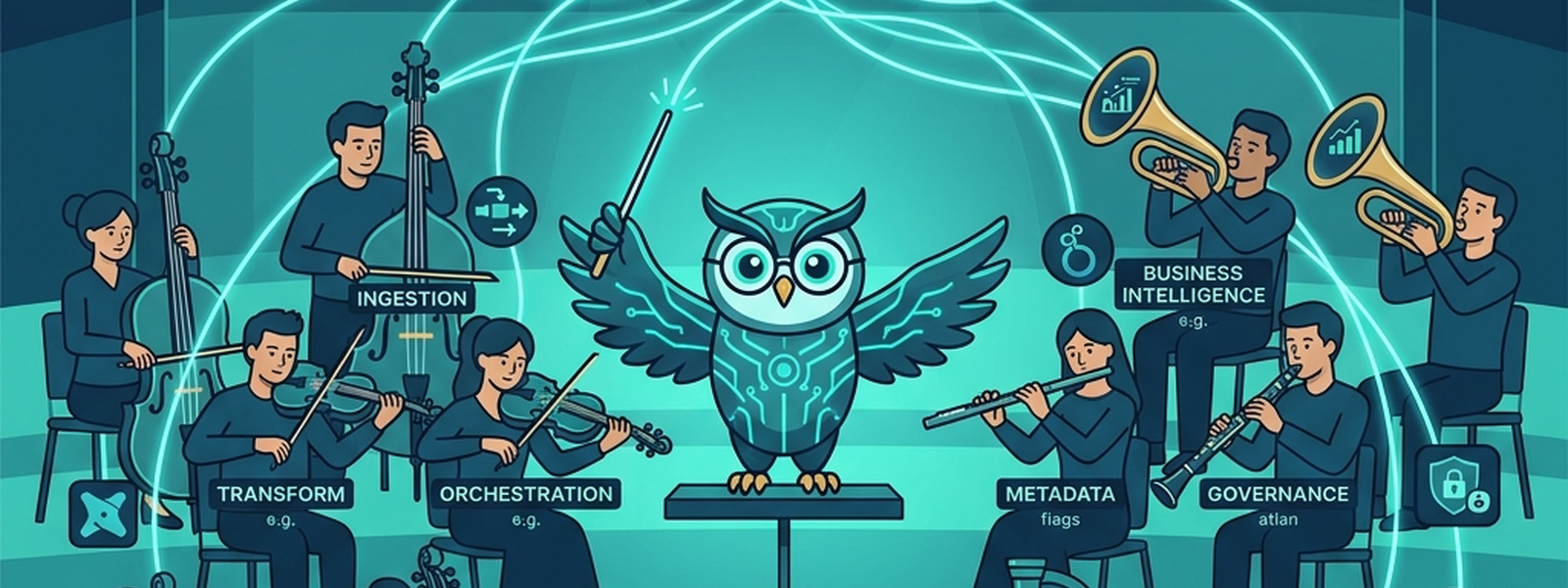
The Composable Data Stack Meets the Agentic Layer
Article 7 of 10 — Analytics Design & Architecture in the AI Era What you’ll take away: why having great instruments isn’t the same as having music, and what it takes to add a conductor without taking over the orchestra.
Opening Scene
Imagine an orchestra where every musician is exceptional. The violinist is one of the best in the world. So is the cellist, the percussionist, the oboist. Each of them, individually, is a masterclass. Now put them all on stage together with no conductor and no shared sheet music, and ask them to play something coherent.
What you’ll get is technically impressive noise. Every instrument is doing something skillful, in isolation — but nothing is actually happening together. What’s missing isn’t talent or tools. It’s coordination: someone, or something, that knows the whole piece, keeps time, and cues each section when it’s their turn to come in.
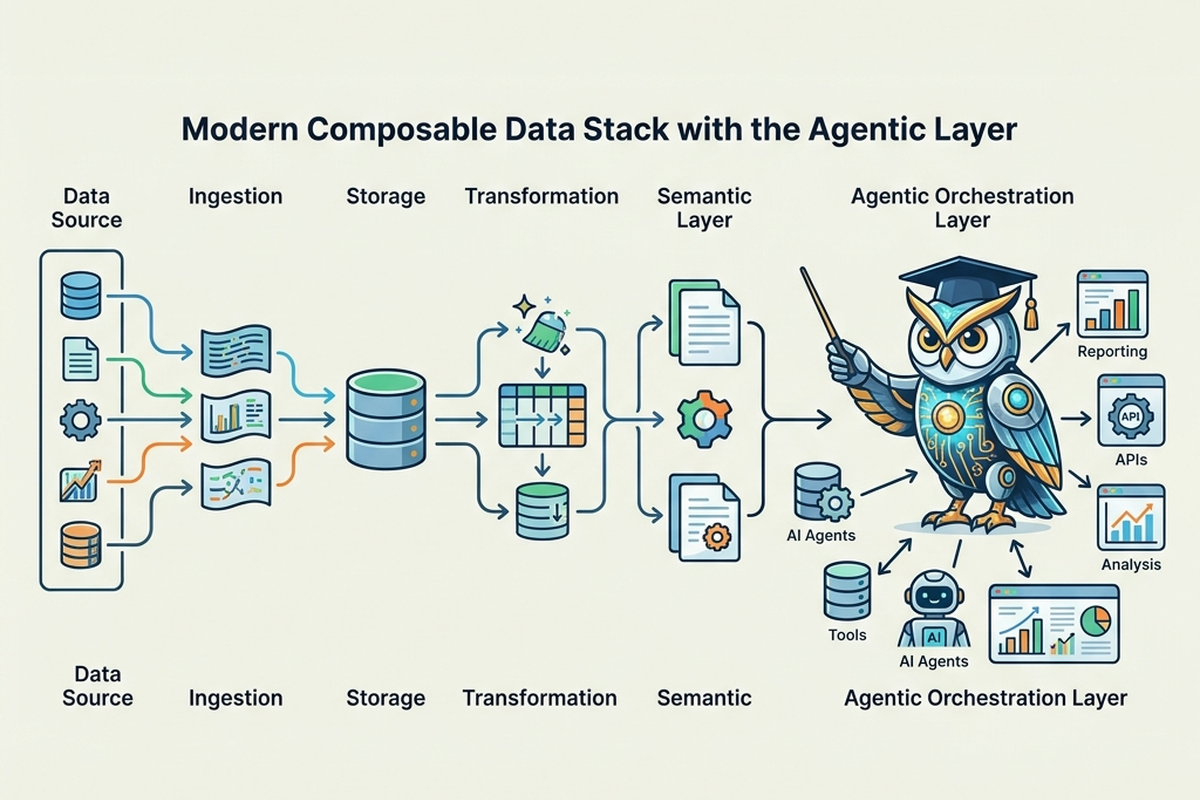
That’s exactly the situation a lot of modern data teams are in. Over the last several years, the move was toward “best-of-breed” tools — a great ingestion tool, a great warehouse, a great transformation layer, a great BI tool, each chosen because it was excellent at its one job. That’s the composable data stack, and it was a real improvement over forcing everything into one rigid, do-everything platform. But excellent instruments still need a conductor. That’s where the agentic orchestration layer comes in — not a new instrument, but the thing that lets all the existing ones actually play together, in time, on cue.
In Plain English
A composable data stack means choosing the best individual tool for each job — ingestion, storage, transformation, BI — instead of one giant platform trying to do everything. It’s modular, like an orchestra made of separately excellent musicians.
An agentic orchestration layer is a new kind of coordinator that can reason across those tools — deciding which one to call, in what order, based on a goal — rather than a human manually stitching every step together every time. It’s the conductor, not another instrument.
The Old Way
In the traditional composable stack, each tool plays its part, but the coordination is handled almost entirely by humans:
- Each excellent musician is a best-of-breed tool — an ingestion platform, a transformation framework, a BI tool — each genuinely good at its specific job.
- The sheet music is the predefined pipeline: a human engineer wrote out, in advance, exactly which tool does what, in what order, every time.
- The rehearsal schedule is the deployment and scheduling logic — fixed, predictable, the same sequence run again and again.
This worked well for predictable, repeating performances — the same piece, played the same way, on a regular schedule. What it wasn’t built for was improvisation: a new, specific request that doesn’t match any rehearsed piece, where someone needs the orchestra to figure out, on the fly, which sections to bring in and when.
What’s Changing (and Why AI Is the Reason)
1. Someone — or something — now needs to read the room, not just follow the score. An AI-driven orchestration layer can take a goal stated in plain language (“pull this week’s churn data, enrich it with support ticket sentiment, and summarize the trend”) and figure out, dynamically, which tools to call and in what order — rather than requiring a human to have pre-written that exact sequence in advance.
2. The conductor doesn’t replace the musicians — it coordinates them. This is the part that’s easy to get wrong: the goal isn’t to replace your warehouse, your BI tool, or your transformation framework with one big AI system that does everything. It’s to add a coordinating layer that calls on each of those excellent, specialized tools as needed — the same way a conductor doesn’t play every instrument, just directs when each one plays.
3. Without a real score, even a good conductor causes chaos. A conductor without sheet music — without clear definitions of what each tool does, what data means, what “done” looks like — is just waving their arms. This is why everything from Article 2 (machine-readable data models) and Article 4 (governance and lineage) matters even more here: an orchestration layer is only as good as the shared structure it’s coordinating against.
This is the real shift: composability gave us excellent individual tools; the agentic layer is what makes them perform together, on demand, without a human hand-wiring every new request.
The Metaphor, Fully Extended
| The Orchestra (Metaphor) | The Architecture (Technical) |
|---|---|
| Each excellent individual musician | A best-of-breed tool in the composable data stack (ingestion, warehouse, transformation, BI) |
| The written sheet music | A predefined, hand-built pipeline sequence |
| The conductor | The agentic orchestration layer |
| The conductor cueing each section at the right moment | An AI agent calling the right tool, in the right order, based on a goal |
| An orchestra with great musicians but no conductor, playing out of sync | A composable stack with great tools but no coordination layer, requiring manual glue code for every new request |
| A conductor without sheet music, waving arms with no shared structure | An orchestration layer operating without clear semantics or governance underneath it |
| Adding a conductor without disbanding the orchestra | Adding an orchestration layer without replacing the existing best-of-breed tools |
| A guest soloist improvising within the structure the conductor provides | A new ad hoc request handled dynamically by the orchestration layer, still grounded in the existing tools and definitions |
For Beginners: What to Actually Do
- Get familiar with the idea that “which tool does this?” is now sometimes decided dynamically, not just hard-coded. If you see a system that seems to be choosing between multiple tools based on a request, that’s orchestration at work — useful to recognize even before you’re the one designing it.
- Don’t assume an orchestration layer replaces your specialized tools. If someone says “we’re adding an agent layer,” ask what it’s coordinating, not what it’s replacing. A good answer should still mention your warehouse, your BI tool, and your transformation framework by name.
- Notice how much “manual glue” currently holds your team’s workflows together. Scripts that move data from one tool to another, run on a schedule, by hand-coded logic — these are exactly the seams that orchestration layers are designed to take over. Recognizing them is the first step to understanding why this shift matters.
For Practitioners and Leaders: The Deeper Layer
- Treat orchestration as a coordination layer, not a platform replacement strategy. The value of composability — picking the best tool for each job — doesn’t go away when you add an agentic layer. The orchestration layer should sit across your existing best-of-breed tools, calling them as needed, not replacing them with one monolithic AI system that quietly reintroduces the very lock-in composability was meant to avoid.
- The orchestration layer’s reliability is bounded by the clarity of what it’s coordinating. This ties directly back to Articles 2 and 4: an agent deciding which tool to call, and how, depends on accurate metadata, clear tool capabilities, and governed definitions. Investing in orchestration without investing in that underlying clarity just produces a confident conductor working from a blank page.
- Define clear boundaries for what the orchestration layer is allowed to decide autonomously versus what requires human sign-off. Some coordination decisions are low-stakes (which transformation job to run first); others touch governance, cost, or customer-facing outcomes and deserve the same proportional oversight discussed in Article 4.
- Watch for tool sprawl hiding behind orchestration. It’s tempting to keep adding specialized tools because “the orchestration layer will handle the complexity.” At some point, more instruments without more rehearsal time creates its own kind of chaos — orchestration eases coordination, but it doesn’t eliminate the cost of complexity entirely.
Quick Recap
- A composable data stack is a collection of best-of-breed tools, each excellent at one job — like a group of skilled individual musicians.
- Without coordination, even excellent tools produce disconnected results — like musicians playing without a conductor.
- An agentic orchestration layer acts as the conductor: dynamically deciding which tool to call, and when, based on a goal stated in plain language.
- Orchestration should coordinate existing specialized tools, not replace them with one do-everything AI system.
- The orchestration layer is only as reliable as the metadata, governance, and definitions it’s coordinating against — it doesn’t work in a vacuum.
Where This Fits in the Series
Article 6 looked at real-time decision-making within a single stream. This article zoomed out to the bigger architectural picture: how the many specialized tools in a modern data stack get coordinated into something coherent, especially as AI starts making more of those coordination calls itself. Next, in Article 8, we’ll look at a less glamorous but very real consequence of all this: the new trade-offs in cost, compute, and context that come with adding AI throughout the architecture — and how to budget for them deliberately rather than being surprised by the bill.
Subscribe to the Newsletter
Get the latest DataParables articles delivered straight to your inbox.