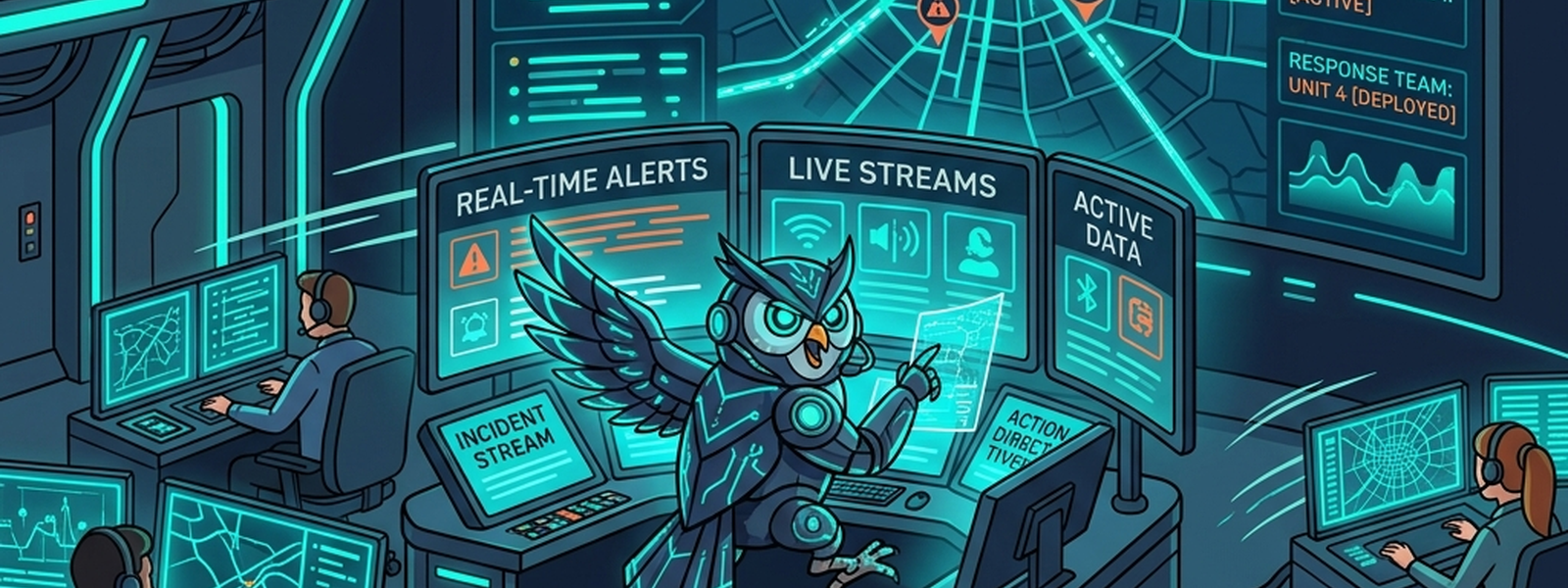
Opening Scene
Imagine a city’s old fire-safety system: once a month, an inspector tallies up incident reports, building complaints, and response times into a summary that lands on a desk. It’s useful for understanding trends — which neighborhoods need more attention, whether response times are improving — but it’s read days or weeks after anything actually happened. Nobody was ever going to put out a fire faster because of last month’s report.
Now picture a modern emergency dispatch center instead. Smoke detectors, traffic sensors, and citizen calls all stream in continuously. A dispatcher — increasingly aided by automated systems — doesn’t wait for a monthly summary; they see an alert the moment smoke is detected, and within seconds, a decision gets made: dispatch a truck, alert nearby residents, reroute traffic around the block. The data doesn’t just get reported. It gets acted on, immediately, while it still matters.
That monthly fire-safety report is the traditional analytics dashboard: useful, but always looking backward. The emergency dispatch center is what real-time, AI-augmented architecture is turning more and more analytics systems into — not just describing what happened, but deciding what happens next, in the moment.
In Plain English
Streaming data means information arriving continuously, as events happen, rather than in a big batch once a day or once a month — like a live sensor feed instead of a monthly report.
What’s new is that AI can now sit inside that live feed and make decisions in real time — flagging a fraud attempt, triggering an alert, adjusting a price — instead of just collecting the data for someone to look at later. The architecture has to shift from “store it so we can report on it” to “watch it so we can act on it,” and that’s a genuinely different design problem.
The Old Way
In the traditional model, the city only has the monthly report:
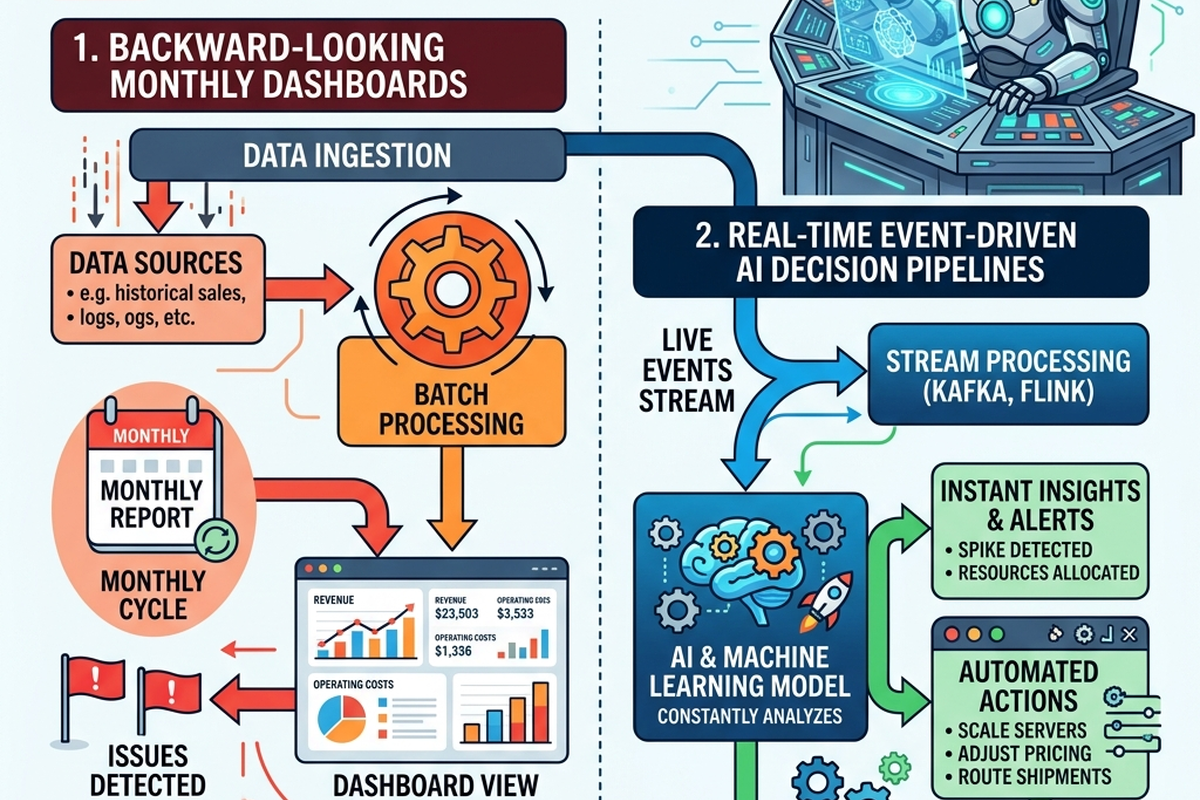
- The monthly summary report is a batch analytics pipeline — data collected over a period of time, processed, and reviewed well after the fact.
- The inspector reading the report is the analyst, identifying patterns and trends after the events are long over.
- Acting on what the report reveals happens on a slow loop — maybe a policy change next quarter, a budget adjustment next year — entirely decoupled from the original event in time.
This worked because, for a lot of business questions, looking backward was genuinely fine. You don’t need real-time data to decide whether to open a new store next year. But for anything where timing matters — fraud, safety, operational bottlenecks, customer experience in the moment — this loop was always too slow, and we simply accepted that as a limitation, because there wasn’t a much better alternative at scale.
What’s Changing (and Why AI Is the Reason)
1. The “inspector” can now watch the live feed, not just the monthly summary. AI models are capable of processing streaming events as they happen — scoring a transaction for fraud risk the instant it occurs, rather than flagging it in next month’s audit. This moves analysis from after-the-fact description to in-the-moment judgment.
2. Decisions are happening at dispatch speed, not report speed. Once an AI model can make a judgment call on streaming data, the natural next step is letting it trigger an action directly — sending an alert, blocking a transaction, adjusting a recommendation — closing the loop in seconds instead of waiting for a human to read a report and decide what to do about it weeks later.
3. Speed creates new risks that a monthly report never had to worry about. A monthly report that’s slightly wrong gets caught and corrected with time to spare. A real-time system that’s slightly wrong might already have blocked a legitimate transaction or sent a false alarm before anyone notices. Acting fast multiplies the cost of being wrong, which means real-time architecture has to take latency, confidence, and fallback behavior far more seriously than batch reporting ever did.
This is why real-time, AI-augmented architecture has to be designed more like an emergency dispatch center than a reporting office: built for continuous watching, fast judgment, and decisive action — with enough care built in that fast doesn’t mean reckless.
The Metaphor, Fully Extended
| The City (Metaphor) | The Architecture (Technical) |
|---|---|
| The monthly fire-safety report | A traditional batch analytics pipeline |
| The inspector reading last month’s numbers | An analyst reviewing historical trends after the fact |
| A policy change made next quarter | A slow decision loop, disconnected in time from the original event |
| The live sensor and call-in feed | A real-time streaming data pipeline (events as they happen) |
| The dispatcher watching the live feed | An AI model scoring or classifying streaming events in real time |
| Dispatching a truck within seconds | An automated action triggered directly from a real-time decision (an alert, a block, an adjustment) |
| A false alarm sent to the wrong block | A real-time AI decision acting on insufficient or low-confidence information |
| A backup protocol for when sensors malfunction | Fallback logic and latency budgets built into the real-time pipeline for when confidence is low or systems fail |
| A senior dispatcher double-checking a borderline call before sending a truck across town | A human-in-the-loop checkpoint for high-stakes, low-confidence, real-time decisions |
For Beginners: What to Actually Do
- Learn to ask “how fresh does this data need to be?” before assuming everything should be real-time. Not every question needs a dispatch center — plenty of good decisions are still made perfectly well from a monthly report. Knowing the difference is a genuinely useful skill, not a limitation.
- When you encounter a real-time system, get curious about what happens when it’s wrong. Is there a way to catch and correct a bad automated decision quickly? If you can’t find an answer, that’s worth flagging, the same way you’d want to know a dispatch center has a backup plan for a broken sensor.
- Notice the difference between “alerting” and “acting.” A system that flags something for a human to review is a very different risk profile than one that takes action automatically. Both are valid designs — but they’re not the same thing, and conflating them is an easy beginner mistake.
For Practitioners and Leaders: The Deeper Layer
- Treat latency as a budget you spend deliberately, not a number to minimize blindly. Every real-time architecture decision trades off speed against accuracy and cost — a more thorough check takes longer; a faster check risks more errors. Decide explicitly how much latency a given decision can tolerate, rather than chasing “as fast as possible” everywhere.
- Design fallback behavior as a first-class requirement, not an edge case. What happens when the model is uncertain, when a service is down, or when an event arrives malformed? An emergency dispatch center has clear backup protocols for sensor failure; your real-time pipeline needs the equivalent — defined, tested, and not improvised under pressure.
- Reserve full autonomy for genuinely low-stakes, well-validated decisions. The higher the cost of being wrong, the more a real-time architecture should lean toward “alert and let a human decide quickly” rather than “act immediately, no review.” This is the same proportional-oversight thinking from Article 4, applied at a faster clock speed.
- Instrument real-time decisions even more rigorously than batch ones. Because there’s less time for a human to catch an error before it matters, the logging, lineage, and audit trail behind a real-time AI decision (tying back to Article 4’s “flight recorder”) needs to be at least as strong as in slower pipelines — arguably stronger, since there’s less opportunity to catch mistakes before impact.
Quick Recap
- Traditional analytics often worked like a monthly report: useful for spotting trends, but always looking backward.
- Real-time, AI-augmented architecture works more like an emergency dispatch center: watching continuously and deciding in the moment.
- Speed multiplies the cost of being wrong, so real-time systems need stronger fallback logic and confidence handling than batch systems ever did.
- “Alerting” (flagging for a human) and “acting” (automated action) are different risk profiles and should be designed as deliberately different patterns.
- Oversight should scale with stakes, even in real-time systems — full autonomy is best reserved for low-risk, well-validated decisions.
Where This Fits in the Series
Article 5 looked at how people interact with analytics in the moment they ask a question. This article extended that “in the moment” thinking to systems that don’t wait to be asked at all — watching streaming data and deciding, sometimes acting, in real time. The governance instincts from Article 4 apply here too, just at a faster pace. Next, in Article 7, we’ll zoom out to the bigger picture of tool architecture itself — how the modern, modular “composable” data stack needs a new orchestration layer to let all these pieces, real-time or not, work together coherently.
Subscribe to the Newsletter
Get the latest DataParables articles delivered straight to your inbox.