
Opening Scene
Picture checking into a large hotel. By the elevator, there’s a laminated map of the building — restaurants on floor 2, the pool on floor 5, conference rooms on floor 3. It’s useful, as long as your question matches exactly what’s printed on it. If you want to know whether the rooftop bar is open right now, or which conference room is free at 3pm today, the map can’t tell you. You have to go find someone, or wander around and check yourself.
Now imagine instead there’s a concierge desk, staffed by someone who actually knows the building — live occupancy, today’s events, which rooms are free right now — and you can just ask them a question in plain language and get a real answer, not a static map pointing vaguely in the right direction.
That laminated map is your traditional dashboard. The concierge who can actually answer your specific question, right now, in plain language, is what conversational and agentic BI is turning self-serve analytics into.
In Plain English
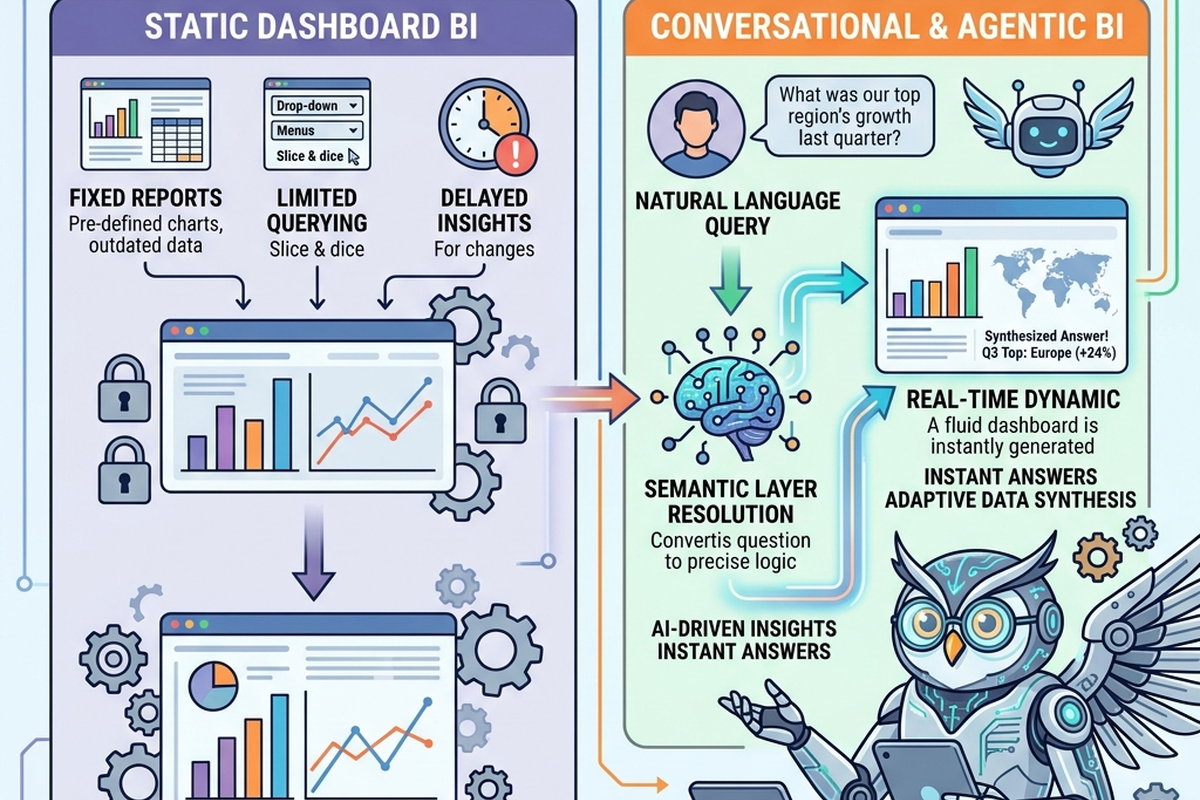
A dashboard is a fixed set of charts someone built in advance, hoping it answers the questions people will ask. It’s useful, but only for the questions it was built to answer.
Conversational or agentic BI lets you ask a question in plain language — “which region’s sales dropped last week and why?” — and get a direct answer, often generated on the fly, instead of hunting through pre-built charts hoping one of them happens to match what you’re really asking.
The Old Way
In the traditional self-serve model, the hotel only offers the laminated map:
- The laminated map is the dashboard — a fixed set of views, designed in advance by someone who guessed which questions people would have.
- Wandering the halls yourself is what happens when your real question isn’t on the map: you go digging through filters, drill-downs, and other dashboards, hoping to stumble onto an answer.
- Asking the one staff member who happens to know things is what happens when self-serve fails entirely and you go find an analyst directly, the same way you’d flag down any hotel employee in the hallway and hope they know the answer.
This worked reasonably well when the number of questions people asked was small and predictable enough that a dashboard designer could anticipate most of them. It works less well when questions are varied, specific, and constantly changing — which, in most real businesses, they always were. We just didn’t have a better option.
What’s Changing (and Why AI Is the Reason)
1. The concierge can actually understand the question as asked, not just the question the map anticipated. Conversational BI tools use language models to interpret a question in plain English and translate it into the right query — without requiring the question to match a pre-built chart. This is the leap from “find the map panel that’s closest to what I want” to “just ask.”
2. The concierge is only trustworthy if the hotel’s own records are solid. Here’s the catch the hype skips past: a concierge who guesses, rather than checks the actual booking system, is worse than no concierge at all — confidently wrong directions waste more of your time than an honest “I don’t know.” This is exactly why Article 2’s semantic layer matters so much here: a conversational BI tool is only as reliable as the well-defined metrics and entities it’s actually querying. Skip that foundation, and you get a confident concierge making things up.
3. “Self-serve” now means a real conversation, not a slightly-better map. The old promise of self-serve analytics was “build enough dashboards that people can find their own answers.” The new promise is closer to “people can simply ask, and get an answer grounded in actual, governed data” — a much higher bar, but a much better experience when it’s built on solid ground.
The Metaphor, Fully Extended
| The Hotel (Metaphor) | The Architecture (Technical) |
|---|---|
| The laminated lobby map | A traditional, pre-built dashboard |
| Wandering the halls looking for an answer | Drilling through filters and other dashboards hoping to find a relevant view |
| Flagging down any staff member and hoping they know | Pinging an analyst directly when self-serve dashboards don’t answer the question |
| The concierge desk | A conversational or agentic BI interface |
| The concierge understanding your specific question | Natural-language-to-query translation (turning plain English into the right analysis) |
| The hotel’s live booking and occupancy system behind the desk | The semantic layer and governed metrics the conversational tool actually queries |
| A concierge who guesses instead of checking the system | An AI model “hallucinating” an answer instead of grounding it in real, defined data |
| A concierge double-checking room availability before confirming | Guardrails and validation steps that confirm an AI-generated answer against actual governed data before presenting it |
| A well-trained concierge who says “let me find out” instead of guessing | A well-designed conversational BI tool that flags uncertainty instead of presenting a guess as fact |
For Beginners: What to Actually Do
- Try asking your data tools a direct question, if they support it, instead of always reaching for a dashboard first. Get a feel for where it works well and where it clearly struggles — that instinct will be valuable as more tools add this capability.
- When a conversational tool gives you an answer, ask yourself “what would this be querying to know that?” If you can’t picture a real underlying metric or table behind the answer, treat it the way you’d treat a concierge who answered a little too quickly and a little too generally.
- Don’t assume fluent and confident means correct. A polished, well-worded answer from a conversational BI tool deserves the same healthy skepticism as a polished, well-worded answer from a brand-new hotel employee who’s never actually checked the booking system themselves.
For Practitioners and Leaders: The Deeper Layer
- The semantic layer is the actual product here — the conversational interface is just the front desk. Investing heavily in a slick natural-language interface without a precise, governed semantic layer underneath it is building an impressive concierge desk in front of an empty booking system. The payoff comes from the foundation, not the UI polish.
- Design explicit guardrails for uncertainty. A good conversational BI architecture should be able to say “I’m not confident in this answer” or “this metric isn’t well-defined for that segment,” rather than always producing a fluent response regardless of underlying data quality. Silence or hedging is a feature, not a failure.
- Plan for a hybrid experience, not a total replacement. Dashboards aren’t going away — they remain useful for monitoring known, recurring questions (the laminated map is still handy for “where’s the pool”). Conversational BI is best designed as a complement for novel, specific questions, not a wholesale replacement for every existing report.
- Instrument the conversational layer the same way you’d instrument any other AI-augmented step (see Article 4). Log what was asked, what was queried, and what was returned, so that when a business user says “this answer seemed off,” you can trace it back the same way you’d trace any other automated decision in the fabric.
Quick Recap
- Traditional self-serve analytics worked like a hotel lobby map: useful only for the specific questions it was built to anticipate.
- Conversational and agentic BI act more like a concierge — able to answer the actual question you ask, in plain language.
- That concierge is only trustworthy if it’s grounded in a solid, governed semantic layer — without that foundation, you get confident, ungrounded guesses.
- Good conversational BI design includes guardrails that surface uncertainty rather than always sounding confident.
- This is a complement to dashboards, not a wholesale replacement — both have a role depending on whether a question is known and recurring, or novel and specific.
Where This Fits in the Series
Articles 1 through 4 covered how the architecture itself — the fabric, the data model, the pipeline, and governance — is adapting to AI moving through every layer. This article turned to the consumption side: how people actually interact with that architecture day to day, and why a good conversational BI experience depends entirely on the foundation laid in the earlier articles, especially the semantic layer from Article 2. Next, in Article 6, we’ll look at what happens when AI doesn’t just answer questions, but acts on streaming data in real time — architecting for systems that need to decide, not just report.
Subscribe to the Newsletter
Get the latest DataParables articles delivered straight to your inbox.