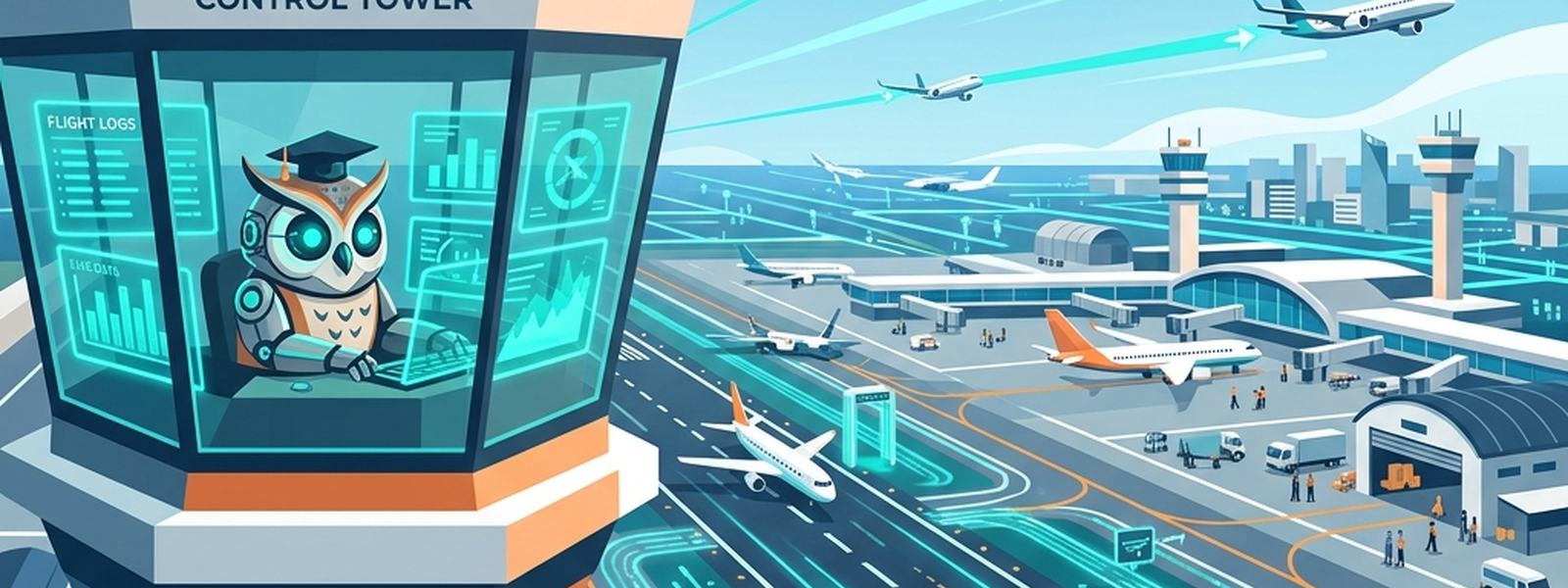
Opening Scene
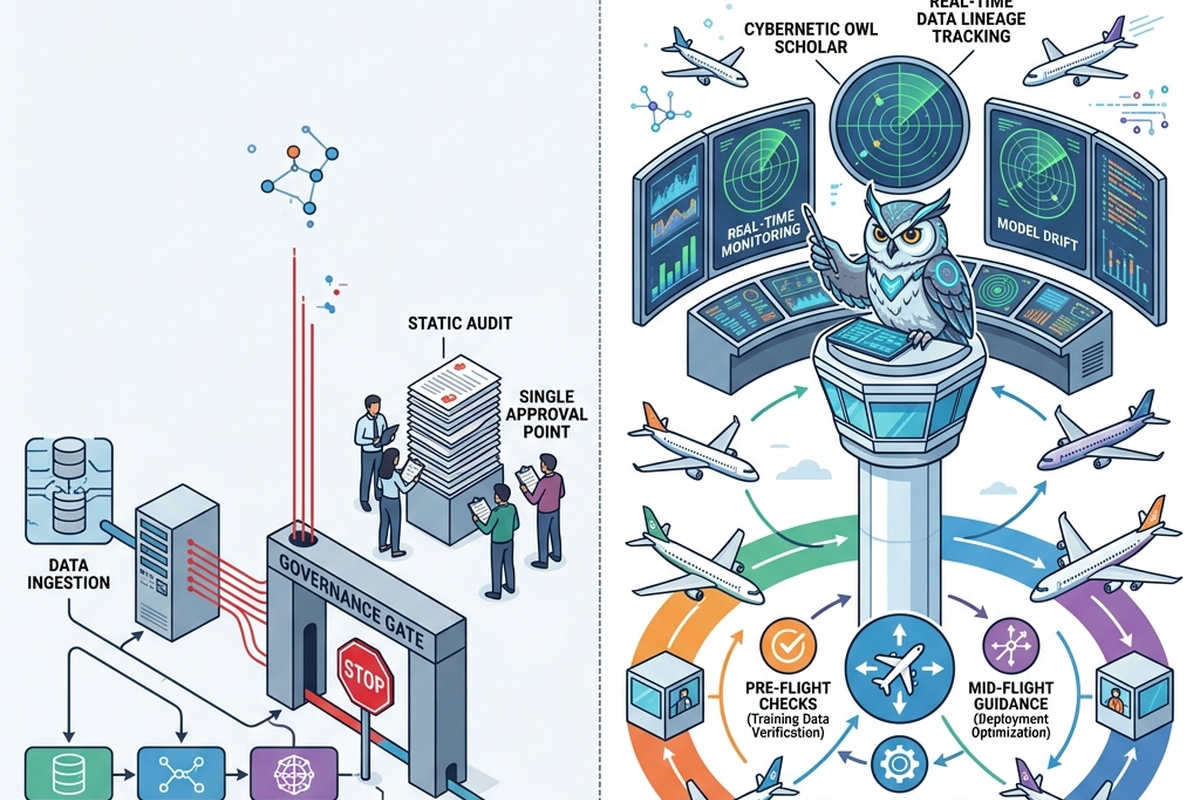
Think about an airport. For a long time, the main safety check happened at one place: security, near the gate, before you boarded. Pass that single checkpoint, and you were essentially trusted for the rest of the journey.
Modern air travel doesn’t work that way anymore — and not because any one checkpoint failed, but because flights got more complex. Now there’s a control tower watching planes in the sky in real time, a flight recorder quietly logging everything that happens in the cockpit, ground crews checking baggage at multiple points, and rules about who’s allowed to make which decisions, in which moment, with backup required for the highest-stakes calls. Safety stopped being one gate and became a system of continuous, distributed watching — because too much was now happening in too many places at once for one checkpoint to catch it all.
That’s exactly the shift happening in analytics architecture. The “one checkpoint near the gate” was governance in the old data stack: a single review step, usually right before a dashboard went live. Now that AI can act, enrich, and decide at many points across the fabric — as we saw in Articles 2 and 3 — governance has to become a control tower watching the whole sky, not a single gate watching one line of passengers.
In Plain English
Governance, in data terms, just means the rules and checks that make sure data — and decisions made from it — can be trusted: where it came from, who touched it, whether it’s accurate, and who’s accountable if something goes wrong.
In the old model, you could mostly get away with checking this once, near the end, before a report went out the door. With AI making changes and decisions at many points throughout the pipeline, you need that same kind of checking happening continuously, in more places — like air traffic control watching the whole sky, not a single security line.
The Old Way
In a traditional setup, trust was enforced at a single, well-known gate:
- The security checkpoint is the one big review step before a dashboard or report ships — a human reviewing numbers, a final QA check, a sign-off meeting.
- The boarding pass is a basic data lineage record — usually just “where did this report come from,” tracked loosely, often only in someone’s memory or a changelog.
- Trusting the rest of the flight once you passed security is the assumption that, once data passed initial review, everything downstream (the dashboard, the slide deck, the decision made from it) was safe by extension.
This worked when there was really only one moment where something could meaningfully go wrong before a human saw the result — much like there was really only one moment, security, where something could go wrong before a flight took off. The further AI moves into the actual flight — not just the gate — the less true that assumption becomes.
What’s Changing (and Why AI Is the Reason)
1. Decisions are happening mid-flight, not just at the gate. As we covered in Article 3, AI can classify, flag, and enrich data throughout a pipeline — not just at one reviewable checkpoint. That means trust-relevant decisions are being made during the flight, in the cockpit, not only before boarding. A single gate-check can’t see any of that.
2. The flight recorder becomes essential, not optional. When a human makes one decision at one point, you can usually reconstruct what happened just by asking them. When an AI model makes dozens of micro-decisions across a pipeline, you need something that behaves like a flight recorder — a detailed, automatic log of what happened, when, and based on what input — because nobody can simply “remember” what an automated system did at 2am across ten thousand records.
3. Some decisions need a co-pilot, not full autopilot. Airlines don’t let every decision happen on full autopilot without a human able to step in — certain situations require a pilot to take the controls. Similarly, not every AI-driven decision in your pipeline should run unsupervised. High-stakes augmentations (flagging fraud, altering a financial figure, summarizing legal text) need a clear point where a human can review or override before it propagates further — what’s often called “human-in-the-loop.”
This is why governance for an AI-augmented architecture has to look like air traffic control: continuous, distributed, and proportionate to risk — not a single gate that assumes everything after it is fine.
The Metaphor, Fully Extended
| The Airport (Metaphor) | The Architecture (Technical) |
|---|---|
| The single security checkpoint near the gate | A traditional, one-time review step before a report or dashboard ships |
| The boarding pass | A loose, manual record of “where this report came from” |
| Trusting the rest of the flight after security | Assuming downstream data is safe once it passed one early review |
| The control tower watching the whole sky | Continuous monitoring and governance across the entire pipeline, not just one stage |
| The flight recorder (“black box”) | Automated lineage and logging — tracking what changed, when, and why, at every step |
| Ground crew checks at multiple points | Distributed validation checks placed throughout the pipeline, not just at the end |
| A pilot able to take over from autopilot | Human-in-the-loop checkpoints for high-stakes AI decisions |
| Air traffic rules that scale with risk (more oversight near busy airports, less in open sky) | Governance that applies stricter checks to higher-stakes data and lighter checks to low-risk data, rather than treating everything identically |
| An incident investigation after a near-miss | Auditing and root-cause analysis when an AI-augmented decision turns out to be wrong |
For Beginners: What to Actually Do
- Ask “where did this number come from?” as a habit, not an accusation. If you can’t trace a figure back through the steps that produced it — including any AI-driven step — that’s a lineage gap worth flagging, the same way a missing boarding pass would raise an eyebrow at the gate.
- Get comfortable with the idea that not all data carries the same risk. A typo in an internal exploratory chart is not the same as an error in a number reported externally. Learning to recognize which is which is a core, transferable judgment skill.
- If you ever see an AI-generated number or label without any way to check how it was produced, say so. That’s not being difficult — that’s exactly the kind of “missing flight recorder” gap that’s worth raising early, before it becomes someone’s bad afternoon.
For Practitioners and Leaders: The Deeper Layer
- Build lineage as an automatic byproduct of the pipeline, not a manual chore. If tracking “what happened to this data” depends on someone remembering to document it, it will fail exactly when you need it most — during an incident. Aim for systems where lineage capture happens automatically as data moves and changes.
- Tier your oversight by risk, the way air traffic control allocates attention by airspace congestion and stakes. Not every AI-augmented field needs a human reviewer; a low-stakes internal tag can run on lighter governance, while anything touching financial reporting, compliance, or customer-facing decisions deserves a defined human checkpoint.
- Design explicit “co-pilot” moments, not vague human oversight. “A person reviews this sometimes” isn’t a control — it’s a hope. Define specifically which decisions require human sign-off, what information that person sees, and what happens if they’re unavailable.
- Treat governance as something the architecture enables, not something bolted on after launch. Just as a control tower needs radar data flowing in continuously to function, governance needs to be designed into the pipeline from the start — logging hooks, confidence scores, and review queues built in as the pipeline is built, not retrofitted after the first incident.
Quick Recap
- Traditional governance worked like a single airport security checkpoint — one review, near the end, with everything downstream implicitly trusted.
- AI-augmented pipelines make decisions throughout the flight, not just at the gate, so a single checkpoint can no longer catch everything that matters.
- Continuous lineage tracking (a “flight recorder”) and distributed checks are now necessary, not optional extras.
- Human-in-the-loop oversight should be deliberately placed at high-stakes decision points, not assumed to be happening everywhere.
- Good governance scales oversight to risk — not every data point needs the same level of scrutiny, but every data point needs some traceable record.
Where This Fits in the Series
Articles 1 through 3 traced how data moves through an AI-augmented architecture — from the fabric itself, to the data model that AI needs to read, to the pipeline steps where AI now does real work. This article covered how to keep that whole system trustworthy as intelligence spreads across it. Next, in Article 5, we shift toward the consumption side of the fabric — what happens when the BI tool itself starts talking back, and people can simply ask their data a question instead of building a dashboard for it.
Subscribe to the Newsletter
Get the latest DataParables articles delivered straight to your inbox.